
Dow Crosses 50,000 as Tech Stocks Roar Back
The Dow Jones Industrial Average smashed through the 50,000 milestone for the first time, closing at 50,115.67 after surging 1,207 points. Nvidia, AMD, Super Micro, Strategy, and Robinhood led a dramatic tech rebound after $1.5 trillion selloff.
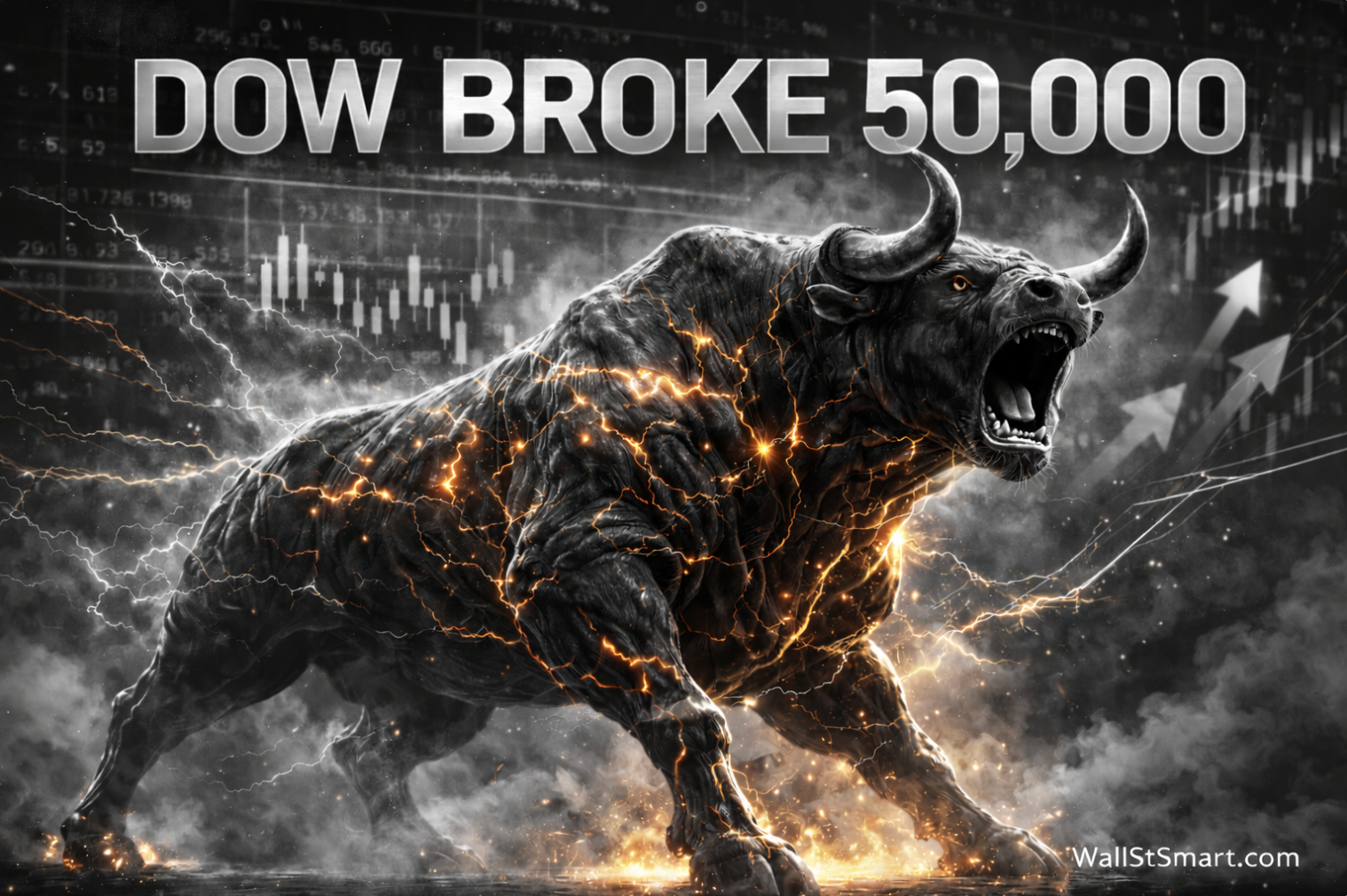
The Dow Jones Industrial Average smashed through the 50,000 milestone for the first time in history on Friday, closing at 50,115.67 after surging 1,207 points (2.47%). The rally marked a dramatic reversal from the brutal tech selloff that wiped $1.5 trillion in market value from the Nasdaq earlier this week.
| Index | Closing Price | Change | % Change |
|---|---|---|---|
| Dow Jones | 50,115.67 | +1,207 | +2.47% |
| S&P 500 | 6,932.30 | +133.9 | +1.97% |
| Nasdaq | 23,031.21 | +491.5 | +2.18% |
But this wasn't just another round-number celebration. This rally revealed which tech stocks investors actually believe can justify their massive AI infrastructure spending, and which ones are facing serious scrutiny going forward. The winners and losers tell a compelling story about where Wall Street thinks AI profits will actually materialize in 2026.
Why Chip Stocks Led the Comeback
Nvidia surged 7.87% to $185.41, reclaiming its position as the AI infrastructure kingpin. The rally came despite zero new fundamental catalysts, suggesting investors used the selloff to buy the dip on a company they still believe will dominate AI compute. Nvidia's forward P/E ratio of just 24.9 (based on non-GAAP fiscal 2027 earnings estimates of $7.66 per share) looks remarkably cheap when you consider the company's revenue projections hit $320 billion for the current fiscal year.
AMD jumped 8.28% to $208.44, bouncing back from a brutal week where it plunged 17% following disappointing guidance. Wall Street's average price target of $286.84 suggests analysts still see 37% upside, though concerns remain about AMD's ability to scale AI volumes before the second half of 2026. The company faces an uphill battle competing with Nvidia's entrenched CUDA software ecosystem, but its cheaper alternatives are finding traction with hyperscalers trying to control costs.
Super Micro Computer rallied 11.44% to $34.38 after delivering crushing Q2 results earlier this week. Revenue surged 123% year-over-year to $12.68 billion, demolishing analyst estimates of $10.43 billion by an impressive 21.5%. The company raised full-year revenue guidance to $40 billion from $36 billion, confirming that AI server demand remains white-hot despite broader market jitters. Trading at just a 10x forward P/E, Super Micro is one of the cheapest ways to play the AI infrastructure buildout.
The Crypto Connection: Strategy and Robinhood Explode Higher
Strategy (formerly MicroStrategy) absolutely exploded 26.11% to $134.93 as Bitcoin recovered above $70,000 after plunging below $60,000 overnight in its steepest decline since mid-2024. The company holds 713,502 Bitcoins with an average purchase price of $76,052, meaning it was underwater on its holdings earlier this week. The recovery provided massive relief, though the company still reported operating losses of $17.4 billion for the quarter compared to $1 billion last year.
Robinhood surged 13.95% to $82.82, riding the Bitcoin bounce alongside broader risk-on sentiment. The trading platform's crypto-related revenue has become increasingly important, representing a massive portion of its transaction revenue growth. With earnings scheduled for February 10, investors will be watching whether the volatile crypto segment can sustain its momentum. The stock remains down 27.9% year-to-date after peaking at $152.46 in October 2025.
Why Applied Digital and MARA Joined the Rally
Applied Digital rocketed 25.52% to $34.95, marking one of the strongest performances in the entire market. The company operates data centers and high-performance computing infrastructure that directly benefit from AI spending trends. When hyperscalers like Amazon, Alphabet, and Meta announce plans to collectively spend over $600 billion on AI infrastructure in 2026 (according to aggregate analyst projections from firms like BofA and Goldman Sachs), companies like Applied Digital are direct beneficiaries.
MARA Holdings jumped 22.44% to $8.24, tracking Bitcoin's recovery. Bitcoin mining stocks amplify Bitcoin price movements, making them extremely volatile but potentially lucrative on big green days like Friday.
The Amazon Problem: Why One Major Stock Couldn't Participate
While most tech stocks rallied, Amazon sank 5.55% to $210.32, continuing its decline after announcing $200 billion in 2026 capital expenditures, a 50%+ increase from 2025. Investors are increasingly questioning whether these massive AI spending commitments will generate proportional returns. Amazon's warning about operating income falling short of expectations spooked the market, raising concerns that the AI infrastructure buildout might compress margins before it expands revenue.
This divergence is critical. The market is pivoting from AI vision to capital efficiency. Companies already monetizing AI investments (like Nvidia selling chips and Super Micro selling servers) got rewarded, while companies making massive capital commitments without clear near-term ROI visibility got punished.
The selectivity was even harsher outside tech. Stellantis plunged 24% after reporting a massive $26 billion writedown tied to its struggling EV and hybrid strategy. The market showed zero tolerance for companies that can't adapt quickly, whether in software, automotive, or any sector caught flatfooted by the AI transformation.
From AI Skepticism to Infrastructure Realism
Thursday saw all three major indexes close significantly lower, with the S&P 500 falling 1.2% to 6,798.40 and the Nasdaq dropping 1.59%. Both the Dow and S&P 500 dipped into negative territory for 2026. The selloff was driven by mounting concerns that $600+ billion in collective AI spending from major tech companies might not generate returns fast enough to justify current valuations.
Friday's reversal suggests investors decided the selloff went too far, at least for the chip companies and infrastructure providers directly benefiting from that spending. The S&P 500's forward 12-month P/E ratio of 22.2 remains elevated above the five-year average of 20.0, but tech bulls argue that AI revenue growth will grow into those valuations over the next 12-18 months.
Industrials and Cyclicals Caught a Bid Too
Beyond tech, cyclical stocks participated heavily in the rally. Caterpillar surged 6% to hit an all-time high above $720 per share, up 25% year-to-date. The construction equipment giant is benefiting from massive data center construction projects, as its power systems division supplies energy infrastructure for AI facilities.
Airlines rallied hard, with Delta and United jumping 7% and 8% respectively. The U.S. Global Jets ETF climbed roughly 5%, marking its best day since August. Small caps surged as well, with the iShares Russell 2000 ETF advancing 3%, bringing its 2026 gains to over 7%.
Is This Rally Sustainable in 2026?
The honest answer is that nobody knows. Wall Street remains split on whether $600+ billion in AI infrastructure spending can translate into proportional revenue growth quickly enough to justify premium valuations. BofA semiconductor analyst Vivek Arya forecasts a 30% year-over-year surge in global semiconductor sales that will push the sector past a historic $1 trillion annual sales milestone in 2026, but he also warned the road will be "choppy."
Key catalysts to watch include Nvidia's earnings on February 25 (which could be the biggest stock market event of 2026 so far), Amazon and Alphabet demonstrating tangible AI revenue growth, and whether chip demand from China accelerates after recent export control relaxations.
Investors should also monitor whether this rotation into cyclicals and industrials has staying power. If the "Magnificent Seven" tech stocks can't deliver on their AI spending promises, money could continue flowing into more traditional sectors trading at reasonable valuations.
Key Takeaways
- Dow crossed 50,000 for first time in history
- Chip stocks rebounded sharply on dip-buying after brutal selloff
- Bitcoin recovery lifted crypto-exposed stocks dramatically
Disclaimer: This article is for informational purposes only and should not be considered financial advice. Stock investing involves significant risk, including potential loss of principal. Always conduct your own research and consult with a qualified financial advisor before making investment decisions.
Recent Articles(9)
View AllWho Is Buying SpaceX at a $1.7 Trillion Valuation?
SpaceX is about to complete the largest IPO in history at a $1.7 trillion valuation, but a sum-of-the-parts analysis puts the company's intrinsic value closer to $350 to $780 billion. Here's why Starlink carries the entire business, why the price is really an AI bet, and what value investors should make of it.
NVTS Forecast 2030: Why Navitas Semiconductor Could Hit $500M (Or More)
Navitas Semiconductor (NVTS) generated $45.9 million in 2025 revenue while management targets a $3.5 billion serviceable market by 2030. Here's a probability-weighted look at where NVTS annual revenue could actually land in 2030, and why the stock has rallied nearly 1,000% in a year.
Will NVIDIA Stock Hit $300 in 2026? A Probability-Weighted Forecast
Can NVIDIA stock reach $300 by end of 2026? Three Wall Street banks say yes, with BofA at $320 and Tigress at $360. Here's the probability-weighted breakdown ahead of NVDA's Q1 FY2027 earnings on May 20.
Trump Just Disclosed Up to $750M in Q1 Stock Trades. The AI Infrastructure Pattern Is Hard to Ignore
President Trump disclosed more than 3,700 securities transactions worth up to $750 million in Q1 2026, with several buys landing one to two weeks before favorable regulatory decisions in those exact names. Here's what the AI infrastructure pattern signals for retail investors and where the second-derivative trade lives.
How to Track Smart Money: A Free Tool for Following Institutional Investors
Track 67 of the most-followed institutional investors managing $1.11 trillion in equities through SEC 13F filings. Our new free Superinvestor Tracker lets retail investors compare hedge fund and asset manager portfolios side by side without paying for a Bloomberg terminal.
Which Stock Will Be the First $6 Trillion Company?
Nvidia just closed at a $5.05 trillion market cap. Alphabet is hot on its heels at $4.80 trillion. The race to be the first $6 trillion company is closer than most retail investors realize, but the math still favors one name. Here is the realistic breakdown of who gets there first in 2026 and why.
RAM Prices Are Exploding: Inside the Great Memory Squeeze Wall Street Underestimated
DRAM contract prices surged 55-60% QoQ as AI demand permanently rewired the global memory market. Here are the top 10 memory makers by market share, which stocks win from the supercycle, and why server OEMs like Dell and HP are getting margin-crushed.
CoreWeave Just Locked In Meta and Anthropic in 48 Hours. Is CRWV a Buy in 2026?
CoreWeave locked in $21B from Meta and a multi-year Anthropic deal in 48 hours, pushing backlog to $87.8B. Is CRWV stock a buy in 2026? Here is the probability-weighted take.
How the Iran War Quietly Became the Biggest Threat to AI Infrastructure Stocks
The Iran war wasn't just an oil story, it was a stress test for AI infrastructure stocks. Here's how IREN, CoreWeave, Nebius, and Nvidia are really exposed to energy cost shocks, and which names look best positioned after the ceasefire.
About WSS Team
WallStSmart editorial team delivering professional financial analysis and market insights.
Follow on Twitter