
Why SanDisk (SNDK) Stock Is Exploding: The AI Data Storage Gold Rush Explained
SanDisk (SNDK) stock surged over 1,000% from post-spinoff lows as AI data centers face a massive NAND flash shortage. Q2 2026 earnings crushed estimates with $6.20 EPS and 64% data center growth.
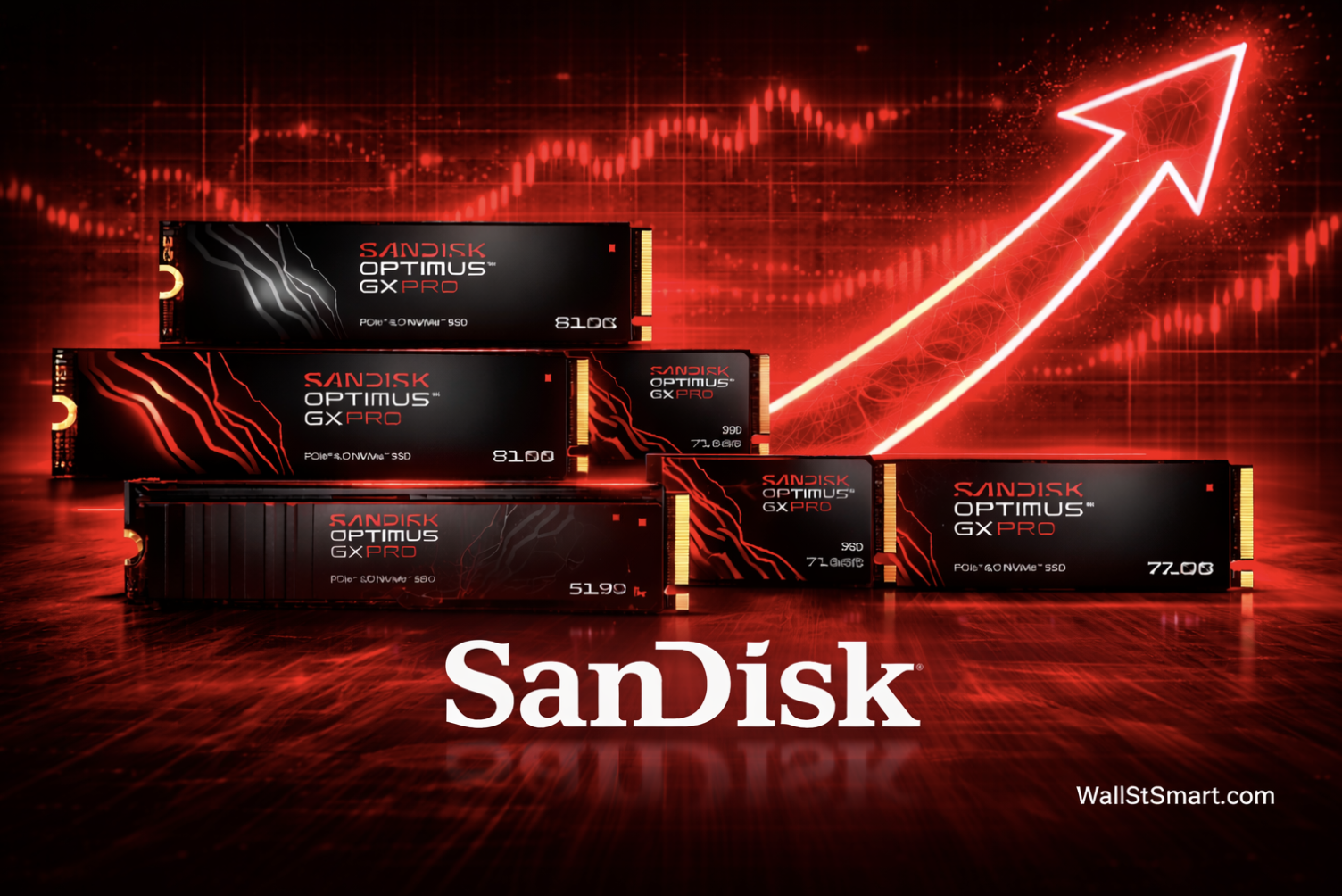
Three Key Points:
- Strategic Pure-Play: SanDisk's 2025 spin-off from Western Digital created a specialized NAND flash powerhouse perfectly timed for the AI boom.
- Structural Supply Deficit: A global shortage in NAND memory and Enterprise SSDs is projected to last through 2027, giving SanDisk unprecedented pricing power.
- Blowout Q2 2026 Earnings: Revenue of $3.03 billion and a 400% surge in EPS have triggered a wave of analyst price target hikes to $1,000.
Here is something you don't see every day in the semiconductor world: a legacy brand up over 1,000% from its post-separation lows in less than a year. That is the meteoric reality of SanDisk (NASDAQ: SNDK). If you are wondering why Wall Street suddenly treats this storage company like a high-flying AI chipmaker, the answer is simple: we are in the middle of an artificial intelligence infrastructure supercycle, and memory is the new bottleneck.
SanDisk just delivered one of the most explosive earnings reports of 2026, proving that the storage industry has shifted from a cyclical "commodity" business to a high-margin, mission-critical component of the global AI data center buildout.
The Spin-Off That Created a Powerhouse
To understand why SanDisk is leading the pack, we have to look at the Western Digital (WDC) separation of 2025. For years, Western Digital struggled with a "conglomerate discount," where its slow-growing Hard Disk Drive (HDD) business dragged down the valuation of its high-growth NAND flash division. Under pressure from activist investors like Elliott Management, the companies finally split in February 2025.
Western Digital kept the legacy HDD business, while SanDisk Corporation emerged as a pure-play NAND flash and Solid State Drive (SSD) company. This timing was flawless. As SanDisk began trading independently at approximately $48 per share, the "AI gold rush" moved from GPUs to the storage layer. Today, the stock has eclipsed $570, with major firms like Bernstein recently raising their price targets to $1,000.
Q2 2026: The Earnings Report That Shattered Expectations
SanDisk's fiscal Q2 2026 earnings report, released on January 29th, was the primary catalyst for the recent 10% single-day jump. The numbers weren't just a "beat"; they were a total re-rating of the company's earning power.
The company reported Non-GAAP diluted earnings per share (EPS) of $6.20, nearly doubling the analyst consensus of $3.49–$3.62. Revenue hit $3.03 billion, a 61% year-over-year increase. However, the "holy grail" metric for investors was the Data Center segment revenue, which surged 64% quarter-over-quarter to $440 million.
This growth is being driven by the rapid adoption of Gen5 Enterprise SSDs and SanDisk's proprietary BiCS8 technology. As hyperscalers (Microsoft, Google, Meta) race to build larger training clusters, they are moving away from traditional HDDs toward high-speed flash storage to reduce latency in AI model inference.
The AI Storage Shortage: Why Prices Are Skyrocketing
Why is SanDisk's margin expanding so fast? We are currently facing a structural NAND flash shortage that hasn't been seen in thirty years. Major players like Micron, Samsung, and SK Hynix have diverted a massive portion of their manufacturing capacity toward High-Bandwidth Memory (HBM) to satisfy NVIDIA's demand for GPU-linked memory.
This has left a massive hole in the supply of standard NAND used for enterprise storage. According to industry reports from TrendForce, contract prices for Enterprise SSDs are projected to climb by more than 40% in early 2026. SanDisk is operating in an allocation environment, meaning they are literally picking and choosing which customers to supply based on who offers the highest margins.
Furthermore, OpenAI's reported "Stargate" project and other massive data center initiatives have effectively "locked up" global memory production capacity through the end of 2026. If you aren't already on a supply contract, you simply can't get the chips—giving SanDisk's joint venture with Kioxia a massive competitive moat in manufacturing scale.
Wall Street's $1,000 Vision: Is SNDK Still a Buy?
Following the Q2 results, the analyst community has turned hyper-bullish. Bernstein SocGen raised its price target from $580 to $1,000, projecting that FY27 EPS could hit $90.96—nearly triple the current consensus. Mizuho and Goldman Sachs have also joined the fray, raising targets to the $700–$750 range, citing "unprecedented pricing power."
For retail investors, the valuation question is complex. At 16x forward earnings for 2027, the stock looks cheap if the shortage is structural. However, memory has historically been a boom-and-bust cycle. If AI spending cools or Samsung brings massive new capacity online in 2027, the "NAND supercycle" could peak.
The Verdict for Retail Investors
SanDisk (SNDK) is no longer a "storage brand" you buy at Best Buy; it is an AI infrastructure play. Its pure-play exposure to NAND flash gives it more direct leverage to the SSD shortage than more diversified giants.
While the stock is up nearly 50% year-to-date in 2026, the guidance for Q3 revenue of $4.4B–$4.8B suggests the party is just getting started. Investors should keep a close eye on NAND contract pricing and hyperscale CapEx reports to see if this momentum is sustainable. For now, SanDisk is the undisputed king of the AI storage gold rush.
Disclaimer: This article is for informational purposes only and should not be considered financial advice. Stock investing involves significant risk, including potential loss of principal. Always conduct your own research and consult with a qualified financial advisor before making investment decisions.
Recent Articles(9)
View AllWho Is Buying SpaceX at a $1.7 Trillion Valuation?
SpaceX is about to complete the largest IPO in history at a $1.7 trillion valuation, but a sum-of-the-parts analysis puts the company's intrinsic value closer to $350 to $780 billion. Here's why Starlink carries the entire business, why the price is really an AI bet, and what value investors should make of it.
NVTS Forecast 2030: Why Navitas Semiconductor Could Hit $500M (Or More)
Navitas Semiconductor (NVTS) generated $45.9 million in 2025 revenue while management targets a $3.5 billion serviceable market by 2030. Here's a probability-weighted look at where NVTS annual revenue could actually land in 2030, and why the stock has rallied nearly 1,000% in a year.
Will NVIDIA Stock Hit $300 in 2026? A Probability-Weighted Forecast
Can NVIDIA stock reach $300 by end of 2026? Three Wall Street banks say yes, with BofA at $320 and Tigress at $360. Here's the probability-weighted breakdown ahead of NVDA's Q1 FY2027 earnings on May 20.
Trump Just Disclosed Up to $750M in Q1 Stock Trades. The AI Infrastructure Pattern Is Hard to Ignore
President Trump disclosed more than 3,700 securities transactions worth up to $750 million in Q1 2026, with several buys landing one to two weeks before favorable regulatory decisions in those exact names. Here's what the AI infrastructure pattern signals for retail investors and where the second-derivative trade lives.
How to Track Smart Money: A Free Tool for Following Institutional Investors
Track 67 of the most-followed institutional investors managing $1.11 trillion in equities through SEC 13F filings. Our new free Superinvestor Tracker lets retail investors compare hedge fund and asset manager portfolios side by side without paying for a Bloomberg terminal.
Which Stock Will Be the First $6 Trillion Company?
Nvidia just closed at a $5.05 trillion market cap. Alphabet is hot on its heels at $4.80 trillion. The race to be the first $6 trillion company is closer than most retail investors realize, but the math still favors one name. Here is the realistic breakdown of who gets there first in 2026 and why.
RAM Prices Are Exploding: Inside the Great Memory Squeeze Wall Street Underestimated
DRAM contract prices surged 55-60% QoQ as AI demand permanently rewired the global memory market. Here are the top 10 memory makers by market share, which stocks win from the supercycle, and why server OEMs like Dell and HP are getting margin-crushed.
CoreWeave Just Locked In Meta and Anthropic in 48 Hours. Is CRWV a Buy in 2026?
CoreWeave locked in $21B from Meta and a multi-year Anthropic deal in 48 hours, pushing backlog to $87.8B. Is CRWV stock a buy in 2026? Here is the probability-weighted take.
How the Iran War Quietly Became the Biggest Threat to AI Infrastructure Stocks
The Iran war wasn't just an oil story, it was a stress test for AI infrastructure stocks. Here's how IREN, CoreWeave, Nebius, and Nvidia are really exposed to energy cost shocks, and which names look best positioned after the ceasefire.
About Sarah Chen
Senior Market Analyst with 10+ years of experience covering tech stocks and AI sector developments.
Follow on Twitter