
What Are Prediction Markets? The Basics Explained
When Polymarket called the 2024 election correctly while polls showed a toss-up, prediction markets went mainstream. Here's how binary contracts work, where people are trading, and the critical warning every investor needs to understand before participating.
Key Takeaways
- Prediction markets are exchange-traded platforms where binary contracts pay $1.00 if an event happens or $0.00 if it doesn't. The trading price represents probability: a contract at $0.65 implies a 65% chance. Polymarket's accurate 2024 election forecast (Trump at 58% when polls showed 50-50) brought mainstream attention to these platforms.
- Three major platforms dominate: Kalshi (CFTC-regulated, fiat-based, legal in U.S.), Polymarket ($3.3B in 2024 election volume, crypto-based, working on U.S. compliance), and PredictIt (politics-only, 93% accuracy but steep 15% total fees). Each offers different market access and regulatory approaches.
- Critical investor warning: Prediction markets are closer to gambling than investing. Unlike the S&P 500's 100% positive returns over any 20-year period, binary contracts offer no compounding, dividends, or long-term wealth creation. Economic hedging contracts may have portfolio value, but sports and political bets are pure speculation dressed in financial market aesthetics.
When the polls said the 2024 presidential election was a toss-up, prediction markets were telling a different story. Platforms like Polymarket had Trump trading at around 60 cents on the dollar weeks before Election Day, which turned out to be far closer to reality than most traditional polling. That accuracy caught a lot of people's attention, and suddenly everyone wanted to know what prediction markets actually are.
At the most basic level, prediction markets are exchange-traded platforms where you can buy and sell contracts tied to real-world events. Think of them as financial markets, except instead of betting on whether Apple stock goes up or down, you're betting on whether specific events will happen. Will the Fed cut rates in March? Will a particular team win the championship? Will inflation hit a certain level by year-end?
The key difference from regular stock trading is the payout structure. These markets use what's called binary contracts, and they're pretty straightforward once you understand the mechanics.
How Binary Contracts Actually Work
Every prediction market contract has two possible outcomes: yes or no. The contract pays exactly $1.00 if the event happens and $0.00 if it doesn't. There's no middle ground, which is why they're called binary.
Because the maximum payout is locked at $1.00, the current trading price effectively tells you what the market thinks the probability is. If a "yes" contract is trading at $0.65, the market is saying there's a 65% chance that event will happen. According to research from the University of Iowa, prediction markets have historically outperformed traditional polls in forecasting election outcomes, especially when looking months ahead.
The math is simple. Buy a contract at $0.40. If the event happens, you collect $1.00, making a $0.60 profit. If the event doesn't happen, you lose your entire $0.40 stake. All or nothing.
The 2024 Election Example
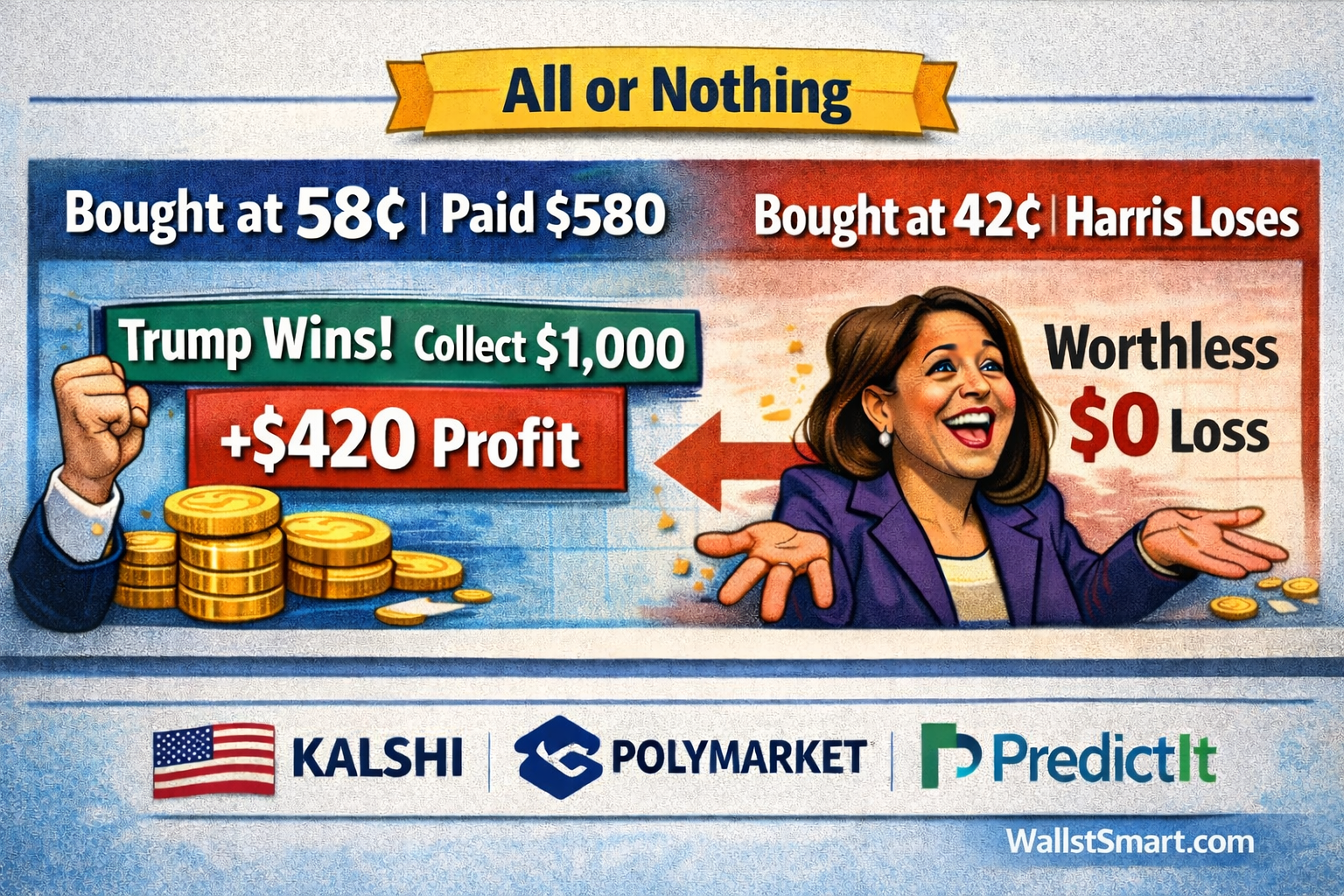
In October 2024, you could have bought a "Trump wins presidency" contract on Kalshi for around $0.58. The market was pricing in roughly a 58% chance of victory, even though most polls showed the race as essentially even.
If you spent $580 buying 1,000 contracts at $0.58 each and Trump won, those contracts settled at $1.00 each. Your payout: $1,000 total, giving you a $420 profit. Anyone who bought "Harris wins" contracts at $0.42 lost everything when she didn't win. The contracts expired worthless at $0.00.
Prices moved constantly based on new information. After the September debate, Harris contracts spiked. After favorable Trump polling in swing states, his contracts climbed. The market reacted in real time, creating a live probability forecast that updated faster than any poll.
Where People Are Actually Trading
Kalshi is the federally regulated option, operating under CFTC oversight. After winning a landmark legal battle in 2024, Kalshi became the first legal prediction market offering political event contracts in the U.S. You can fund with bank transfers or debit cards, and they offer markets on everything from economic data to sports outcomes.
Polymarket runs on blockchain technology and processed over $3.3 billion in volume during the 2024 election cycle. The platform uses USDC (a stablecoin) for transactions and doesn't charge trading fees. They're working on a regulated U.S. product after acquiring CFTC-licensed infrastructure.
PredictIt focuses exclusively on political markets and is known for having some of the most accurate political forecasts, though it charges steep fees (10% on profits plus 5% on withdrawals).
The Critical Warning Investors Need to Understand
Here's what prediction market platforms won't tell you upfront: this is fundamentally closer to gambling than investing, no matter how they market it.
Charles Schwab's research makes this distinction clear. Real investing has positive expected returns over time. The S&P 500 has delivered positive returns 100% of the time over any 20-year period since 1928. Meanwhile, gambling always has negative expected returns because the house edge guarantees money flows from players to the casino.
Prediction markets fall somewhere in between, but they're much closer to the gambling side. You're making binary bets on single events with total capital at risk. There's no compounding, no dividends, no long-term value creation. Win or lose everything. That's a casino payout structure, not an investment return profile.
Economic event contracts tied to Fed decisions or recession probability might have some hedging value if you're protecting an existing portfolio. But sports contracts, entertainment bets, political outcomes? Those aren't correlated to your investment returns. They're just gambling with financial market aesthetics.
Treat prediction markets like the casino, not your retirement account. If you participate, use only money you're completely comfortable losing, understand it's speculation rather than investing, and keep it separate from your actual wealth-building strategy. The math doesn't lie: over time, diversified investing builds wealth. Binary betting doesn't.
Disclaimer: This article is for informational purposes only and should not be considered financial advice. Stock investing involves significant risk, including potential loss of principal. Always conduct your own research and consult with a qualified financial advisor before making investment decisions.
Recent Articles(9)
View AllWho Is Buying SpaceX at a $1.7 Trillion Valuation?
SpaceX is about to complete the largest IPO in history at a $1.7 trillion valuation, but a sum-of-the-parts analysis puts the company's intrinsic value closer to $350 to $780 billion. Here's why Starlink carries the entire business, why the price is really an AI bet, and what value investors should make of it.
NVTS Forecast 2030: Why Navitas Semiconductor Could Hit $500M (Or More)
Navitas Semiconductor (NVTS) generated $45.9 million in 2025 revenue while management targets a $3.5 billion serviceable market by 2030. Here's a probability-weighted look at where NVTS annual revenue could actually land in 2030, and why the stock has rallied nearly 1,000% in a year.
Will NVIDIA Stock Hit $300 in 2026? A Probability-Weighted Forecast
Can NVIDIA stock reach $300 by end of 2026? Three Wall Street banks say yes, with BofA at $320 and Tigress at $360. Here's the probability-weighted breakdown ahead of NVDA's Q1 FY2027 earnings on May 20.
Trump Just Disclosed Up to $750M in Q1 Stock Trades. The AI Infrastructure Pattern Is Hard to Ignore
President Trump disclosed more than 3,700 securities transactions worth up to $750 million in Q1 2026, with several buys landing one to two weeks before favorable regulatory decisions in those exact names. Here's what the AI infrastructure pattern signals for retail investors and where the second-derivative trade lives.
How to Track Smart Money: A Free Tool for Following Institutional Investors
Track 67 of the most-followed institutional investors managing $1.11 trillion in equities through SEC 13F filings. Our new free Superinvestor Tracker lets retail investors compare hedge fund and asset manager portfolios side by side without paying for a Bloomberg terminal.
Which Stock Will Be the First $6 Trillion Company?
Nvidia just closed at a $5.05 trillion market cap. Alphabet is hot on its heels at $4.80 trillion. The race to be the first $6 trillion company is closer than most retail investors realize, but the math still favors one name. Here is the realistic breakdown of who gets there first in 2026 and why.
RAM Prices Are Exploding: Inside the Great Memory Squeeze Wall Street Underestimated
DRAM contract prices surged 55-60% QoQ as AI demand permanently rewired the global memory market. Here are the top 10 memory makers by market share, which stocks win from the supercycle, and why server OEMs like Dell and HP are getting margin-crushed.
CoreWeave Just Locked In Meta and Anthropic in 48 Hours. Is CRWV a Buy in 2026?
CoreWeave locked in $21B from Meta and a multi-year Anthropic deal in 48 hours, pushing backlog to $87.8B. Is CRWV stock a buy in 2026? Here is the probability-weighted take.
How the Iran War Quietly Became the Biggest Threat to AI Infrastructure Stocks
The Iran war wasn't just an oil story, it was a stress test for AI infrastructure stocks. Here's how IREN, CoreWeave, Nebius, and Nvidia are really exposed to energy cost shocks, and which names look best positioned after the ceasefire.
About WSS Team
WallStSmart editorial team delivering professional financial analysis and market insights.
Follow on Twitter