
Which White-Collar Jobs Are Most at Risk from AI in 2026?
Anthropic researchers published a detailed map of AI job displacement risk, measuring the gap between what AI can theoretically do and what it is actually doing today. Financial analysts, programmers, and sales reps top the exposure list. Here is what it means for your portfolio.
Key Takeaways
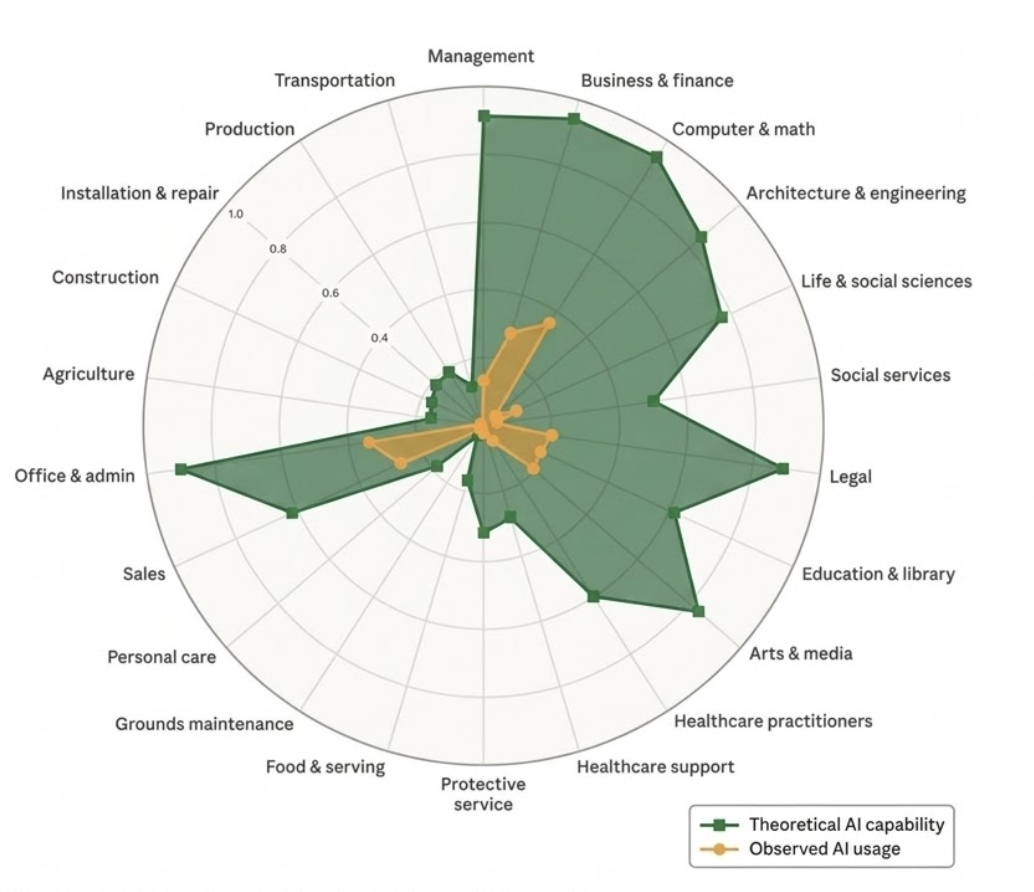
- AI can theoretically handle 94% of programmers' tasks but covers only 33% today.
- Financial analysts, programmers, and sales reps face the highest AI displacement risk.
- Closing the AI adoption gap is bullish for infrastructure and bearish for SaaS.
The company that built Claude just turned its AI on one of the most important questions of this decade: which jobs is AI actually replacing, and which ones is it merely circling? The answer, drawn from real-world Claude usage data across professional settings, should matter to every investor holding tech stocks right now.
Anthropic researchers Maxim Massenkoff and Peter McCrory published a study this week titled "Labor market impacts of AI: A new measure and early evidence." It introduces what they call "observed exposure," a metric that compares AI's theoretical capability to handle a job's tasks against how much it's actually being used to do those tasks today. The gap between those two numbers is where the real story lives.
The Gap Between What AI Can Do and What It's Actually Doing
The headline finding is striking. For computer and math professionals, large language models are theoretically capable of handling 94% of their tasks. Actual observed usage in professional settings? Just 33%. Office and administrative roles show a similarly wide gap, with roughly 90% theoretical coverage against a fraction of that in practice.
The researchers attribute the lag to legal constraints, model limitations, the need for additional software tooling, and the reality that humans still review AI outputs. But they are clear: those are temporary friction points, not permanent barriers. As capabilities improve and enterprise adoption deepens, that red area of actual usage will grow to fill the blue area of what is possible.
For investors, this is not a comforting footnote. It is a roadmap.
Which White-Collar Jobs Are Most at Risk from AI in 2026?
Based on Anthropic's analysis, these are the ten professions with the highest share of tasks AI could potentially automate:
- Computer programmers: 75% task exposure
- Customer service representatives: 70%
- Data entry keyers: 67%
- Medical record specialists: 67%
- Market research analysts and marketing specialists: 65%
- Sales representatives: 63%
- Financial and investment analysts: 57%
- Software quality assurance analysts: 52%
- Information security analysts: 49%
- Computer user support specialists: 47%
The demographic profile of the most exposed workers is not what most people expect. According to the research, the most AI-exposed group is 16 percentage points more likely to be female, earns 47% more on average, and is nearly four times as likely to hold a graduate degree compared to the least exposed group. The lawyer, the financial analyst, the senior software developer. Not the warehouse worker or the line cook.
At the other end of the spectrum, roughly 30% of workers have essentially zero AI exposure: cooks, mechanics, bartenders, landscapers. Jobs requiring physical presence and dexterity that no large language model can replicate.
Is AI Job Displacement Already Happening? The Hiring Slowdown Signal
The researchers are careful not to overstate what the data shows today. There is currently no systematic increase in unemployment attributable to AI. But there is an early signal worth watching: a 14% drop in the job-finding rate for exposed occupations in the post-ChatGPT era compared to 2022. For workers aged 22 to 25, a separate study found a 16% fall in employment in AI-exposed jobs.
The mechanism is not mass layoffs. It is companies quietly not backfilling roles, shrinking graduate hiring, and using AI to accomplish with smaller teams what previously required larger ones. Jack Dorsey's Block made headlines last month when it cut nearly half its workforce citing AI as a factor, though some analysts including Salesforce CEO Marc Benioff suggested the company may be using AI as cover for cuts it needed to make regardless.
February's jobs report reinforced the nervousness: employers shed 92,000 jobs and the unemployment rate ticked up to 4.4%. The causal link to AI is not proven, but the timing is hard to ignore.
The researchers themselves raise the specter of a "Great Recession for white-collar workers," noting that during the 2007-2009 financial crisis, U.S. unemployment doubled from 5% to 10%. A comparable doubling in unemployment among the top quartile of AI-exposed occupations, from 3% to 6%, is detectable in their framework and, as they put it, absolutely possible. Federal Reserve Governor Michael Barr listed it as one of three plausible AI adoption scenarios in a speech last month.
What AI Job Disruption Means for the Stocks You Own
The investment implications run in two directions simultaneously.
For Nvidia, Microsoft, Alphabet, and Meta, this research is structurally bullish. Every percentage point of that observed exposure gap that closes represents more enterprise AI spend, more compute demand, and more cloud revenue. The Anthropic findings effectively confirm that AI adoption in professional settings is still very early. Companies building the infrastructure for that adoption have a long runway ahead.
The more complicated picture is for Salesforce, Workday, and the broader enterprise software category. If AI closes even half the gap in financial analysis, sales operations, and customer service over the next two years, the seat-based SaaS model that powers those companies' margins comes under real pressure. The $285 billion selloff triggered by Anthropic's Cowork plugins in February was the market's first visceral reaction to this dynamic. It almost certainly will not be the last.
The study makes a point that does not get enough attention: professions with high AI exposure are projected to grow more slowly through 2034, per Bureau of Labor Statistics data. Software companies whose valuations rest on selling tools to exactly those professions should be on your watchlist for structural downside risk, not just cyclical fluctuation.
Retail investors should think of this research the way you would think about any credible earnings pre-announcement: it does not tell you exactly what will happen or when, but it changes the probability weights you should assign to different scenarios. The companies sitting in the path of this shift, whether as beneficiaries or casualties, are named and knowable. The full Anthropic research paper is worth reading for investors who want the underlying methodology.
Disclaimer: This article is for informational purposes only and should not be considered financial advice. Stock investing involves significant risk, including potential loss of principal. Always conduct your own research and consult with a qualified financial advisor before making investment decisions.
Recent Articles(9)
View AllWho Is Buying SpaceX at a $1.7 Trillion Valuation?
SpaceX is about to complete the largest IPO in history at a $1.7 trillion valuation, but a sum-of-the-parts analysis puts the company's intrinsic value closer to $350 to $780 billion. Here's why Starlink carries the entire business, why the price is really an AI bet, and what value investors should make of it.
NVTS Forecast 2030: Why Navitas Semiconductor Could Hit $500M (Or More)
Navitas Semiconductor (NVTS) generated $45.9 million in 2025 revenue while management targets a $3.5 billion serviceable market by 2030. Here's a probability-weighted look at where NVTS annual revenue could actually land in 2030, and why the stock has rallied nearly 1,000% in a year.
Will NVIDIA Stock Hit $300 in 2026? A Probability-Weighted Forecast
Can NVIDIA stock reach $300 by end of 2026? Three Wall Street banks say yes, with BofA at $320 and Tigress at $360. Here's the probability-weighted breakdown ahead of NVDA's Q1 FY2027 earnings on May 20.
Trump Just Disclosed Up to $750M in Q1 Stock Trades. The AI Infrastructure Pattern Is Hard to Ignore
President Trump disclosed more than 3,700 securities transactions worth up to $750 million in Q1 2026, with several buys landing one to two weeks before favorable regulatory decisions in those exact names. Here's what the AI infrastructure pattern signals for retail investors and where the second-derivative trade lives.
How to Track Smart Money: A Free Tool for Following Institutional Investors
Track 67 of the most-followed institutional investors managing $1.11 trillion in equities through SEC 13F filings. Our new free Superinvestor Tracker lets retail investors compare hedge fund and asset manager portfolios side by side without paying for a Bloomberg terminal.
Which Stock Will Be the First $6 Trillion Company?
Nvidia just closed at a $5.05 trillion market cap. Alphabet is hot on its heels at $4.80 trillion. The race to be the first $6 trillion company is closer than most retail investors realize, but the math still favors one name. Here is the realistic breakdown of who gets there first in 2026 and why.
RAM Prices Are Exploding: Inside the Great Memory Squeeze Wall Street Underestimated
DRAM contract prices surged 55-60% QoQ as AI demand permanently rewired the global memory market. Here are the top 10 memory makers by market share, which stocks win from the supercycle, and why server OEMs like Dell and HP are getting margin-crushed.
CoreWeave Just Locked In Meta and Anthropic in 48 Hours. Is CRWV a Buy in 2026?
CoreWeave locked in $21B from Meta and a multi-year Anthropic deal in 48 hours, pushing backlog to $87.8B. Is CRWV stock a buy in 2026? Here is the probability-weighted take.
How the Iran War Quietly Became the Biggest Threat to AI Infrastructure Stocks
The Iran war wasn't just an oil story, it was a stress test for AI infrastructure stocks. Here's how IREN, CoreWeave, Nebius, and Nvidia are really exposed to energy cost shocks, and which names look best positioned after the ceasefire.
About WSS Team
WallStSmart editorial team delivering professional financial analysis and market insights.
Follow on Twitter