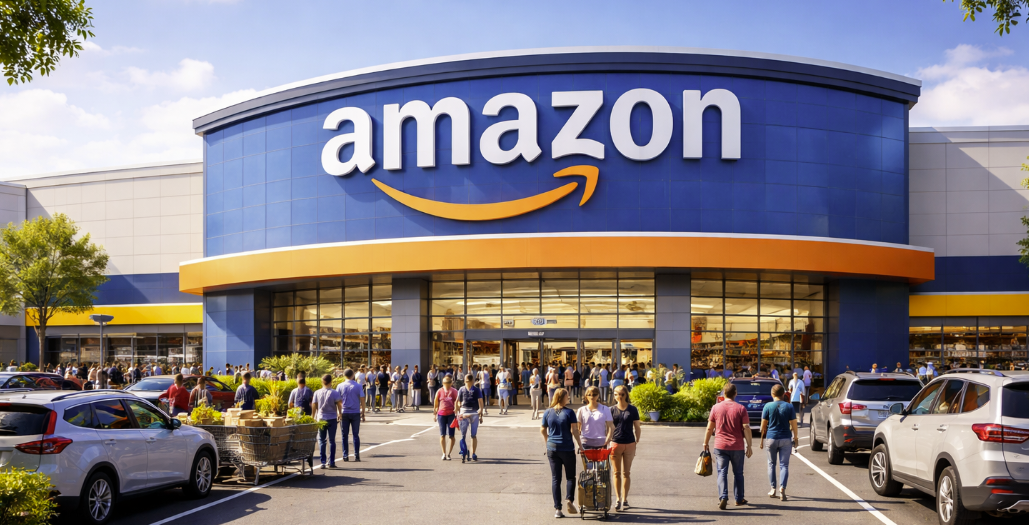
Amazon's Walmart-Sized Gamble: Inside the 230,000 Square Foot Megastore Strategy
Amazon just got approval to build its first-ever megastore — a 230,000 square foot retail concept bigger than the average Walmart Supercenter. Here's what this strategic shift means for investors and why 93% of Amazon customers still shopping at Walmart forced this move.
W
WSS Team
January 25, 2026•8 min read
Key Takeaways
Amazon approved for 230,000 sq ft megastore, larger than average Walmart Supercenter.
93% of Amazon customers still shop at Walmart despite $100B grocery sales.
Investment carries 60-70% success probability based on scale economics and execution risk.
# Amazon's Walmart-Sized Gamble: Inside the 230,000 Square Foot Megastore Strategy
**Key Takeaways:**
- Amazon received approval for a 230,000 square foot megastore in Orland Park, Illinois, larger than the average Walmart Supercenter at 179,000 square feet, with groundbreaking potentially starting April 2026 and opening in late 2027.
- 93% of Amazon customers still shop at Walmart despite Amazon generating over $100 billion in grocery sales annually, revealing a massive addressable market that Amazon hasn't captured with its existing formats.
- The investment represents a 60-70% probability of success based on scale economics, but carries execution risk given Amazon's previous struggles with physical retail formats like Amazon Books, 4-star stores, and Amazon Fresh.
---
Amazon just got approval to build something it's never attempted before, and the move tells you everything about where retail competition is headed in 2027. The company's planning a 230,000 square foot retail store in Orland Park, Illinois, about 30 miles southwest of Chicago. That's bigger than your average Walmart Supercenter, which typically clocks in around 179,000 square feet.
[The Orland Park Village Board approved the project on January 20, 2026](https://chicago.suntimes.com/real-estate/2026/01/20/amazon-approval-build-massive-new-retail-concept-orland-park), with groundbreaking potentially starting as early as April and a late 2027 opening. This isn't just another [Amazon Fresh](https://www.wallstsmart.com/stocks/AMZN) or Whole Foods expansion. This is Amazon admitting that capturing [Walmart's customers](https://www.wallstsmart.com/stocks/WMT) requires beating Walmart at its own game.
## The Numbers That Forced Amazon's Hand
Here's the stat that probably keeps Amazon executives up at night: **93% of Amazon customers still shop at Walmart**, [according to Consumer Intelligence Research Partners](https://www.geekwire.com/2026/amazon-supersizes-its-walmart-rivalry-with-new-big-box-retail-concept/). Despite dominating online retail and running Whole Foods, Amazon hasn't cracked the code on capturing everyday grocery and household spending the way Walmart has.
The company's grocery business already generates over $100 billion annually and serves more than 150 million U.S. shoppers. But that's still leaving massive revenue on the table. [Walmart reported $681 billion in total revenue for its latest fiscal year](https://ideas.darden.virginia.edu/walmart-versus-amazon), while Amazon came in at $638 billion. If current trends hold, Amazon could surpass Walmart this year to become America's largest retailer by revenue. But here's the thing: Amazon knows it can't get there without solving physical retail at scale.
## Why Amazon's Previous Physical Retail Attempts Failed
Amazon's track record with brick-and-mortar stores outside of Whole Foods has been rough. The company tried Amazon Books, Amazon 4-star stores (which only sold products with four-star ratings or better), and Amazon Fresh grocery locations. Most of these concepts either closed or saw stop-and-go growth. [Amazon Go convenience stores still exist but haven't scaled meaningfully](https://www.grocerydive.com/news/amazon-big-box-store-plans-walmart-grocery/809423/).
The problem wasn't execution; it was scale and format. Small-format stores work for convenience purchases, but they don't capture the weekly big-basket shopping trips that drive consistent revenue. Walmart figured this out decades ago with its Supercenter model, combining groceries and general merchandise under one massive roof. Now Amazon's finally building that same format, just with tech-enabled ordering and fulfillment baked in.
## What Makes This Store Different
[The Orland Park store will sell groceries, household essentials, and general merchandise](https://www.cnbc.com/2026/01/09/amazon-plans-first-big-box-retail-store-in-chicago-suburb.html), all without requiring an Amazon Prime membership to shop there. That's a critical detail because it signals Amazon wants to compete for every customer, not just its subscription base. The location sits at a major intersection surrounded by [Costco](https://www.wallstsmart.com/stocks/COST), [Target](https://www.wallstsmart.com/stocks/TGT), and yes, a Walmart Supercenter. Amazon's intentionally picking a fight on Walmart's home turf.
The store will also integrate app-based ordering with in-store shopping, allowing customers to order products from inside the store and pick them up before leaving. [This hybrid model represents Amazon's attempt to merge its digital infrastructure with traditional retail](https://www.pymnts.com/news/retail/2026/amazon-and-walmart-swap-scripts-as-retails-agentic-future-looms/), something Walmart has been working toward from the opposite direction.
The project spans 35 acres at the former Petey's II restaurant site and includes 800 parking spaces. Amazon plans to create approximately **200 construction jobs and 500 permanent positions** once the store opens. The village expects significant sales and property tax revenue from the development, which will fund planned traffic improvements in the corridor.
## The Investment Case: What This Means for Amazon Stock
[Amazon stock](https://www.wallstsmart.com/stocks/AMZN) is currently trading around **$231 per share**, up about 5% over the past year but well off its November 2025 high of $254. The market's been digesting what Amazon's next growth phase looks like, especially as AWS growth moderates and competition intensifies across all segments.
This megastore strategy could move the needle on Amazon's retail profitability. Physical stores offer better unit economics on groceries and bulky household goods compared to delivery. If Amazon can capture even a fraction of those 93% of its customers who currently drive to Walmart for basics, that's billions in incremental revenue with potentially higher margins than home delivery.
But here's the risk: Amazon's estimated to invest hundreds of millions into this single store between construction, inventory, and staffing. [The project is expected to create 200 construction jobs and 500 permanent positions](https://thebossmagazine.com/article/inside-amazons-largest-physical-store-yet/). If this format flops like Amazon's previous retail experiments, that's a lot of capital down the drain. The company hasn't released how many additional megastores it plans beyond this first location, which suggests this is genuinely an experiment, not a rollout.
The smart bet here is probability-weighted: Amazon has a **60-70% chance of finding some version of success** with this format, primarily because they're finally building at the scale that makes physical retail economics work. The 30-40% failure scenario comes from execution challenges, customer adoption, or simply discovering that Walmart's decades of supply chain and real estate optimization can't be replicated quickly.
## How This Reshapes Amazon vs Walmart Competition
Amazon and Walmart are essentially swapping playbooks. [Walmart's racing ahead with digital commerce, AI shopping agents, and drone delivery](https://www.pymnts.com/news/retail/2026/amazon-and-walmart-swap-scripts-as-retails-agentic-future-looms/), while Amazon's building massive physical stores. Both companies recognize that the future of retail isn't purely online or purely physical. It's about controlling the entire shopping experience across channels.
For Amazon shareholders, this represents a maturing strategy. The company's moving beyond pure e-commerce dominance into building an omnichannel retail empire that can compete in every format. That's the right long-term play, even if it requires massive upfront investment and creates near-term margin pressure.
The competitive dynamics are shifting in real time. While Amazon generated $638 billion in revenue last year, the gap with Walmart's $681 billion is narrowing. But revenue alone doesn't tell the full story. Walmart's retail media business grew **33% year-over-year**, and combined with membership fees, now accounts for roughly one-third of operating income. Amazon's AWS remains its profit engine, but physical retail done right could significantly boost the company's overall profitability.
## The Retail Real Estate Angle
This megastore approval also signals something important about retail real estate. Amazon chose Orland Park specifically because it's a dense suburban retail corridor with heavy foot traffic and established shopping patterns. The location strategy mirrors what made Walmart successful: build where people already shop, just offer a better experience.
Traffic studies conducted by Amazon projected approximately **10,060 new daily vehicle trips** to the area by 2033, representing about a 5-6% increase. The village is implementing traffic mitigation measures including new traffic signals, turn lanes, and a road extension to handle the increased volume.
## What Comes Next
The Orland Park store opens in late 2027. If it works, expect Amazon to accelerate store openings in suburban markets nationwide. If it struggles, Amazon will quietly pivot back to smaller formats or double down on improving its existing Fresh and Whole Foods operations. Either way, this is Amazon making its biggest physical retail bet yet, and the implications for [Walmart](https://www.wallstsmart.com/stocks/WMT), traditional grocery chains like [Kroger](https://www.wallstsmart.com/stocks/KR), and retail real estate will play out over the next 3-5 years.
The key metrics to watch will be revenue per square foot compared to Walmart Supercenters, customer acquisition cost, and whether Amazon can leverage its digital infrastructure to create a genuinely differentiated in-store experience. If those numbers work, this single store becomes a template. If they don't, it becomes an expensive learning experience.
For retail investors, this development reinforces a broader theme: the battle between Amazon and Walmart is no longer about online versus offline. It's about who can build the most comprehensive retail ecosystem that serves customers however they want to shop. That's a much more capital-intensive competition, but it's the one that will define the next decade of retail.
---
*The data and analysis in this article are for informational purposes only and should not be considered investment advice. Markets are inherently uncertain, and past performance does not guarantee future results. WallStSmart provides institutional-grade research tools for retail investors to make informed decisions.*